Bridging the gap between static streaming and social connection for the under-35 audience.
Team
Seven Designers (including myself)
UX Researcher, Product Manager (iHeartMedia)
Tools Used
Figma, UserTesting, Miro
Timeline
3 months (One Semester)
BYTE-SIZED INFO
tl;dr
iHeartMedia was losing the battle with retaining users under the age of 35, churning rapidly due to an impersonal experience. Research revealed a critical 82% drop-off rate during onboarding, driven by navigational friction and a lack of social connection.
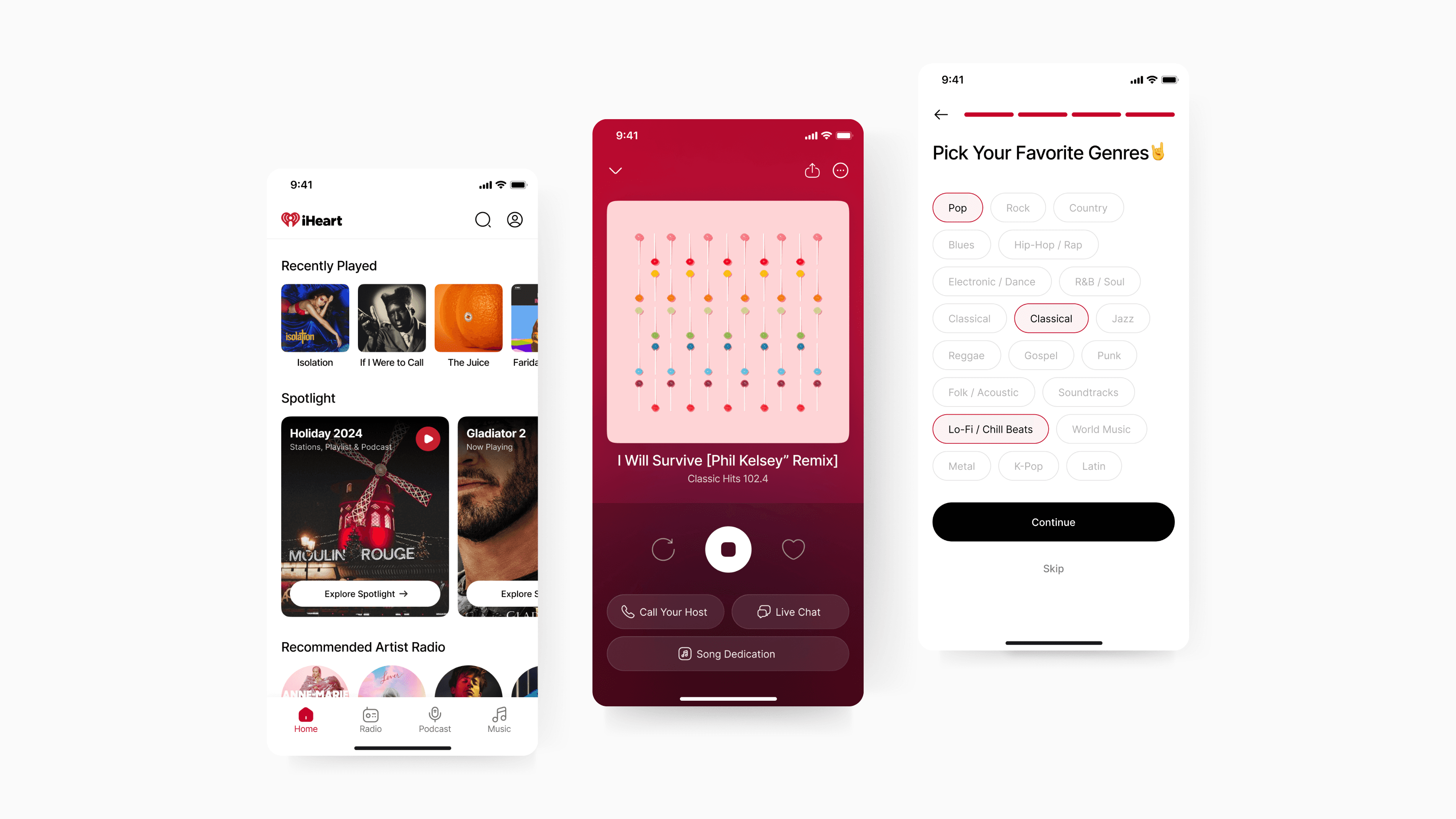
The final solution focuses on navigation and community. I streamlined the onboarding flow to get users to music faster and introduced Call Your Host and Song Dedication features to mimic the intimacy of live radio.
This project was a part of the Studio Project Course offered by the MS HCI/d program at Indiana University Bloomington.
IMPACT
Increased content engagement by 18%, contributing to longer listening sessions across a platform reaching over 250M monthly users.
THE CHALLENGE
Identifying cracks in the existing journey.
iHeartRadio serves hundreds of millions of listeners every month. At that scale, even tiny moments of hesitation compound into millions of abandoned listening decisions.
USER INTERVIEW QUOTE
"I really want to get the old radio back where I could call on a number and send a song request or even talk to the host…really miss the human interaction there."
MY RESEARCH IDEALOGY
Listening to the noise.
To better understand the factors driving churn, my team and I used several methodologies to gather deeper insights.
Led foundational research, conducting a Heuristic Evaluation and 5 in-depth user interviews.
Analysed 500+ user reviews from various sources like Reddit and App Store.
Research led me to prioritize an engagement-first strategy: optimizing onboarding and adding social features.
DESIGNS v1
The first pass.
#1 Optimizing the Onboarding Funnel (Reducing Churn)
Based on sponsor and user feedback, we streamlined the onboarding process by skipping unnecessary screens and rewriting questions to be more relevant.
#2 Song Dedication
The newly introduced "Song Dedication" feature allows listeners to dedicate a song to anyone live on air and also send out a personalised message to them as a special gesture.
#3 (THE PRODUCT IDEA) In-podcast Interaction
We added in-podcast polls to make the experience of listening to the podcast more interactive and for people to be able to share their thoughts.
TESTING v1
Room to rethink.
Through testing, we discovered four key areas where the users struggled with interaction.
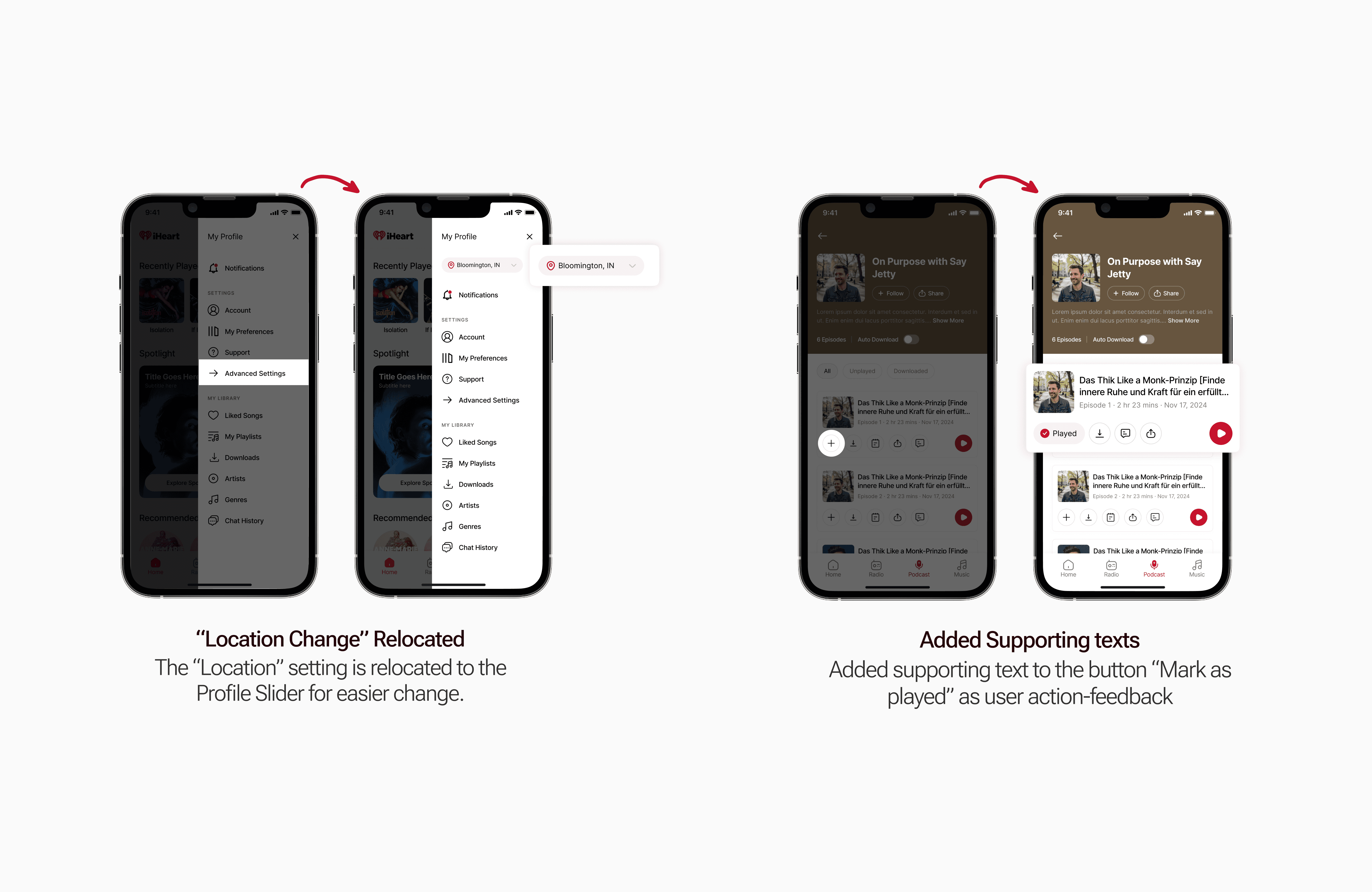
Location: Expectation to find the Location setting in the account section, but finding it hidden under Advanced Settings.
Dedication: Assumption that the Song Dedication feature only applied to the song currently playing on the station.
Button Functions: The Plus button and Transcript button were confusing, with the Plus button's function being the non-obvious "Marked as Played."
Device Transition: Users expected easier and more direct access to output music and transition playback across multiple devices.
INCORPORATING CHANGES
The outcome, revisited.
My key takeaway from testing was the need for clarity and discoverability. For example, users struggled to find hidden functions like "Mark as Played" or change their location settings.
I advocated for moving critical controls (like Location Settings) from an obscure "Advanced" menu to the main "My Profile" page, a small change with a massive impact on user autonomy and successful content delivery.
CHALLENGES
Design limitations.
My team didn't just build the solution. We went a step further and critically examined its boundaries.
Within the live radio interactions, some users might feel a little hesitant about directly calling the Radio Jockey because of privacy issues.
At the time, the company did not have the resources to incorporate a moderator for the live chat/community discussion board features.
The design was also unable to resolve the overload of advertisements on the app due to business constraints.
What stayed with me.
Teamwork
I learned that real teamwork requires understanding and adapting to each other’s working styles while collaboratively figuring out methods that fit the team as a whole.
Taking Ownership
Actively stepping up and taking ownership allows us to experience the joy of success.
Empathy
I recognized the importance of empathy, not only towards our users but also towards each other.
